
State of Frontend Development
As we mentioned yesterday, frontend development has changed over the past years. Back in 2020 there was no Covid (or was there?), Webpack was a popular choice for bundling assets, the term "frontend fatigue" was yet relatively unknown, and jQuery powered 54 millions of websites[1] (roughly 5,4% of the entire internet in 2020[2]). In the same year, ClosedAI released the GPT-3 language model.
Six years later, a few things have happened that have changed slightly the way we do front-end development:
- Webpack is hated by everyone
- Only 5% of the entire internet uses jQuery (that's 0,4% less)
- Large language models (LLM) write code better than us
Since ClosedAI introduced Codex in 2021, AI models have become extremely proficient at writing code. They are faster and more reliable than most of us, simple humans. And they don't complain.
Even more, with the rise of Agentic AI, tasks that used to take days to plan, implement, test and ship now take minutes or hours.
Unless you have been living in a cave for the last 5 years, the following question probably has been bouncing in your head: Do I have a future as frontend developer?
Frontend Development in 2026
As I wrote at the start of the article, frontend development has changed, but perhaps not in the way you might expect. What has really changed is how we solve problems (more on this later).
There are around 1,4 billion websites[2:1] out there (3 new websites are created every second[3]) that still needs frontend wizardry to center a div. The tools, web browsers, programming languages, are kind of the same. The foundational core of the web's technology is still in place. HTTP still governs how data flows between servers and clients. WHATWG continues to publish HTML standards. The elders of TC39 continue to specify JavaScript.
6 billion people[4] use the Internet daily on this planet. The average user browses the Internet on a smartphone that renders and executes the HTML, CSS and JS of beautiful, fast, performant, accessible web pages.
The new JavaScript framework hype cycle is over. There hasn't been any major new JavaScript framework release in years. However this does not mean that there is no innovation anymore. We are now in a "stable plateau" period, where JavaScript and its ecosystem is kind of mature after 30 years. Now it's the time of the meta-frameworks, compiler optimization, SSR[5] and better and faster tools (rewrite it in Rust!).
Frontend conferences still happen worldwide: JSNation, React Summit, SmashingConf... Some of them with a touch of AI, but it demonstrates that there is a strong interest on sharing, showcasing and learning frontend development.
So, how does this magnificent landscape translate into economic opportunities and frontend jobs?
Reality Check
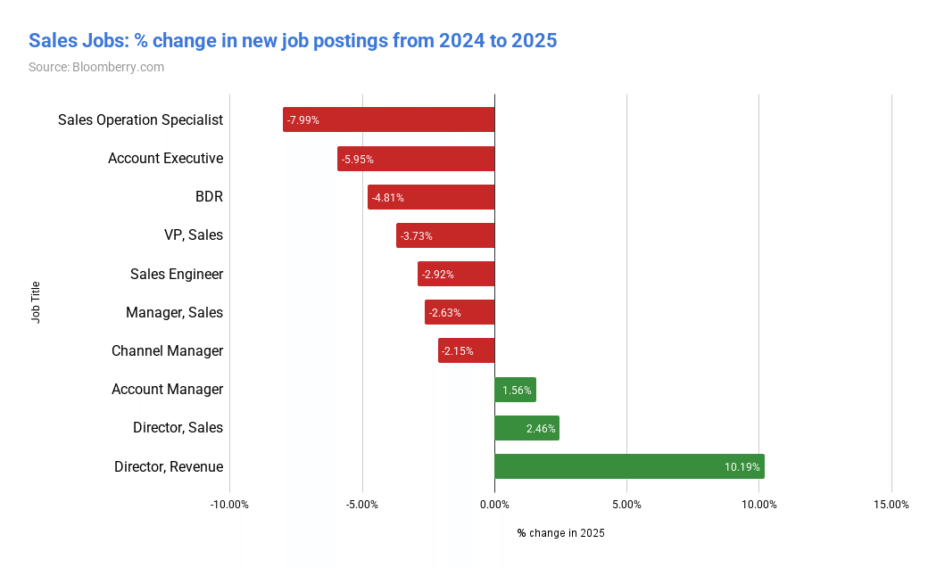
According to bloomberry.com, frontend engineers were the biggest declining software job[6] in 2025. Despite the overwhelming amount of frontend work available, as shown in the previous section, current data indicates that frontend developer roles face a decline due to AI coding tools.
Coding has never been more accessible. Backend engineers lacking aesthetic sense can bake a solid UI without having to touch a single line of CSS. Small to medium companies can leverage AI-driven website builders to create their identity in the Web of Webs. Anyone can build a sleek website with cool frameworks (by which I mean one framework that AIs love), JavaScript components running on the server and wiring a database using an ORM[7]. Getting the gold medal in TypeScript Type Gymnastics is a breeze. An agent can implement new features to your GitHub project and order 40 heads of garlic while you sleep.
All of this translates into fewer job offers for frontend developers roles. But then,
Are We Extinct?
Paraphrasing one of my favorite programmers, AI is to developers what CGI was to stop-motion animators in 1993: a rude awakening[8].

Personally I don't feel frontend development is obsolete, but as frontend developer, I believe we need to evolve to avoid becoming obsolete. Being a good software engineer also means being able to adapt to situations. We should look into diversifying our skill set and shift toward full-stack versatility, because the market is also shifting towards full-stack engineers who can handle more than just the UI.
It is also important your years of expertise as frontend developer to orchestrate AI tools. Human judgment and programming skills remain essential. Programming is essentially about solving problems with specific knowledge to solve it[9]. This involves understanding the core issue, breaking it down into manageable pieces, and implement the logic so a computer can run it.
With a modern AI problem-solving mindset, we can delegate routine, repetitive and preparatory work (have you tried to ship a button in 2026?) to AI, while we simple humans focus on creativity, supervision, and serious thinking (the 30/70 rule applied to AI).
We live in exciting times. The web is evolving into something new. Over the last 30 years we have witnessed several (r)evolutions in the Internet, and the Intelligent Web will not be the last. Enjoy the ride and adapt to it. But during the process don't meet the same fate as Roy Batty.
I've seen things you people wouldn't believe. Attack ships on fire off the shoulder of Orion. I watched C-beams glitter in the dark near the Tannhäuser Gate. All those moments will be lost in time, like tears in rain.
References
https://trends.builtwith.com/javascript/jQuery ↩︎
https://oddballmarketing.com.au/blog/how-many-new-websites-are-created-daily/ ↩︎
https://ourworldindata.org/grapher/number-of-internet-users ↩︎
https://bloomberry.com/blog/i-analyzed-180m-jobs-to-see-what-jobs-ai-is-actually-replacing-today/#bullet8 ↩︎
https://fabiensanglard.net/extinct/index.html ↩︎
https://www.scotthyoung.com/blog/2022/01/04/cognitive-load-theory/ ↩︎